

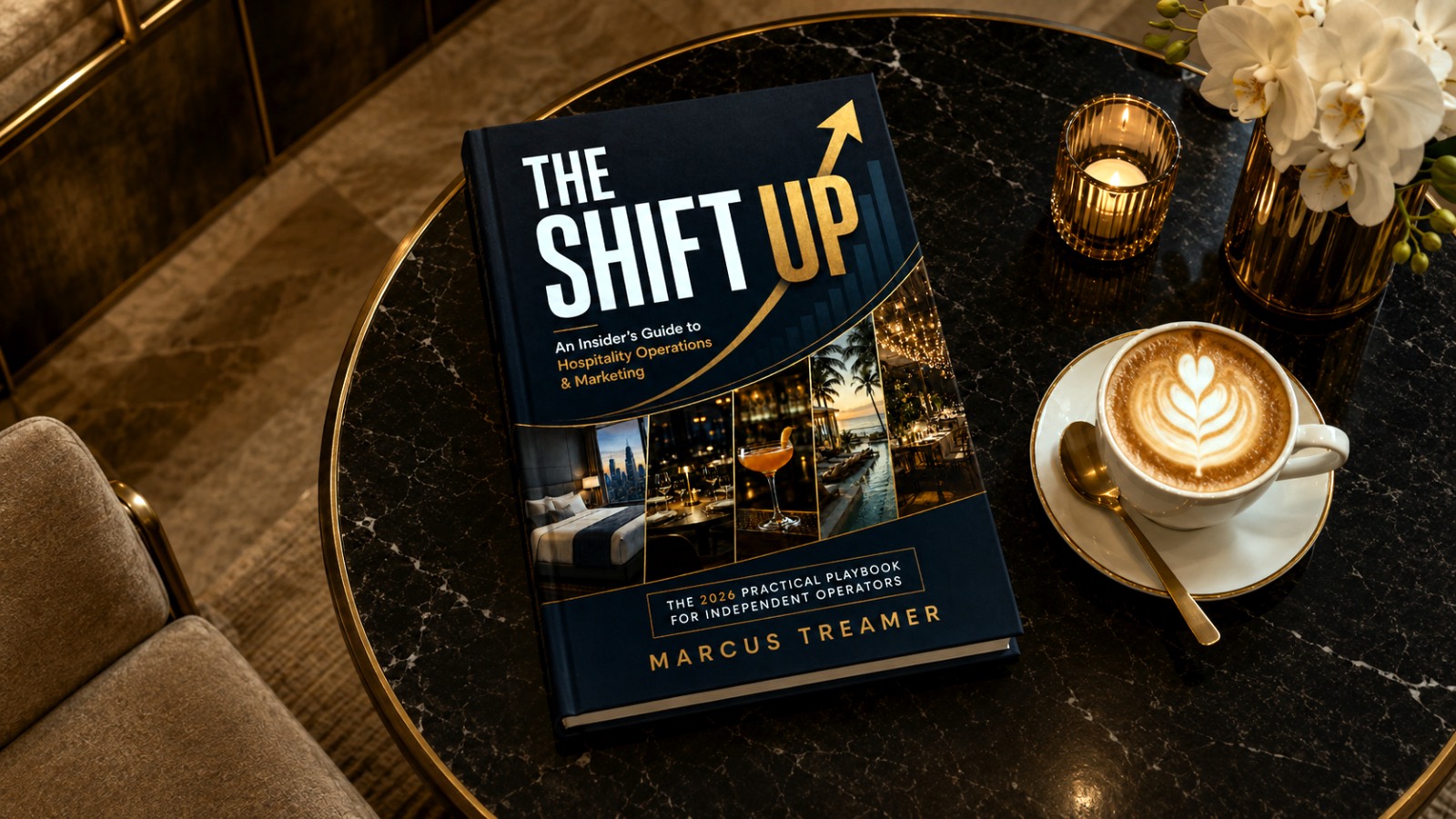
TL;DR: The Shift Up puts practical operational frameworks into one accessible guide for independent operators
Nearly 60 published articles became the research foundation for one coherent guide. The Shift Up draws directly from the insight work on this blog, translating recurring themes into structured frameworks operators can apply immediately.
Four pillars cover the full arc of running a venue. Foundations, Attention and Acquisition, Operational Excellence, and Strategic Intelligence give the book a logical progression from concept to exit.
Every tool is designed for operators working without a support team. Pour cost benchmarks, staffing replacement cost figures, marketing spend thresholds, and menu engineering matrices are built for people who need to use them before Monday's pre-shift.
Two formats at $9.99 each make it genuinely accessible. PDF and EPUB with 19 companion worksheets, or a 7-hour 29-minute audiobook for operators whose reading time happens between service and sleep.
The AI search chapter alone reflects a shift most hospitality guides have not caught up with. Chapter 3 covers how AI-driven search and answer engines have already changed how guests find venues — and what operators must do to remain visible to the systems that now make recommendations.
Why This Book Exists
This blog started as a place to think out loud about the questions that kept surfacing in my consultancy work — the ones that independent operators face repeatedly, without the support structures or resources that larger groups take for granted. Over time, nearly 60 articles accumulated on this site covering everything from raising capital without losing concept control to the mechanics of closing a venue in a way that preserves your reputation and your options. Readers began to tell me the articles were being used as reference material, forwarded to management teams, and bookmarked for later in ways that suggested something more than occasional reading. That told me the thinking was useful. It also told me it needed a better container.
The Shift Up is that container. It is an operator's field guide drawing from those articles, from the work I have done across five markets — Hong Kong, Shanghai, Dubai, Beijing, and Koh Samui — and from twenty-five years of running hospitality from the inside rather than commenting on it from a distance. The subtitle on the cover is the most accurate description I could write: the systems that work on a real Tuesday night. Not the ones that look convincing in a presentation deck. The ones that hold when the second chef does not show up and covers are forty minutes behind.
What the Book Actually Covers
The Shift Up is organised around four pillars, each representing a domain that independent operators cannot afford to neglect and rarely have time to study properly.
The first, Foundations, covers the two decisions that shape everything downstream: building a concept that survives market pressure and competitive imitation without being diluted into something unrecognisable, and raising capital in a way that preserves creative control. The capital chapter is one I wish had existed earlier in my career. The number of operators who discover the implications of their investment structure only after it is too late to renegotiate is a genuine industry problem, and the chapter addresses it plainly.
The second pillar, Attention and Acquisition, is where the book reflects the current moment most directly. Six chapters cover the full landscape of how guests find venues and how operators build the relationships that keep them returning: AI-driven search, community-based retention, the financial case against influencer marketing, social media strategy that does not consume the operation, reputation management, and marketing spend allocation. Chapter 3, on how guests find venues now, covers ground that most hospitality guides have not yet reached — the shift from traditional search rankings to AI answer engines and what operators need to do to remain visible to the systems that are already driving recommendations today. I wrote about this shift at length in the zero-click search article on this blog, and the book develops that thinking into an operational framework.
The third pillar, Operational Excellence, covers the mechanics of running a venue profitably — loyalty programmes that actually work for independents, menu engineering with specific matrices and pricing psychology, beverage programme management by category, staffing in an environment where the structural deficit is no longer a temporary problem, and revenue diversification that generates margin without diluting the core experience. These are chapters built around numbers: pour cost targets, food cost benchmarks, replacement cost per employee by role, and a scoring framework for knowing when diversification becomes a distraction.
The fourth pillar, Strategic Intelligence, addresses two things the industry tends to avoid discussing clearly. The first is how to distinguish structural market shifts from trends that will pass, and how to protect your decision-making from consultants whose incentives do not align with yours. The second is the hold-or-fold assessment for struggling venues, and the mechanics of a managed closure — how to close in a way that preserves relationships, reputation, and the foundation for whatever comes next. It is a chapter the industry barely talks about and operators almost always need.
Two Formats, One Goal
The book is available in two formats at $9.99 each, and the pricing is deliberate. Independent operators are precisely the audience least able to justify a premium cover price for a business book, and precisely the ones who stand to gain most from the thinking inside it.
The PDF and EPUB edition comes with 19 companion worksheets — A4 tools for applying the frameworks directly to your own operation, from the menu engineering matrix to the marketing spend allocation model. Both formats download immediately. The audiobook edition, available on ElevenReader, runs to 7 hours and 29 minutes, with chapter-by-chapter bookmarks for operators whose reading time falls between close and the morning briefing.
The free sample on the site gives you Chapter 1 — The Concept That Survives — before you commit to anything.
For Operators Who Are Already Running
The book is not written for people considering entering hospitality. It is written for operators already inside it, navigating the daily tension between the business they are running and the business they intended to build. The case studies run from fine dining to fast casual, from beach clubs to hotel food and beverage, across markets with wildly different cost structures and consumer behaviours. Where benchmarks differ significantly by segment, the book flags it — pour cost targets for a cocktail bar are not the same as those for a quick-service restaurant, and treating them as equivalent is expensive.
The question I get asked most often about the book, which the FAQ on the site addresses directly, is whether it is relevant outside the UK and US. The honest answer is that it is more international than most operators will need. The case studies draw from over a dozen countries, currency examples span pounds, dollars, Singapore dollars, Thai baht, dirhams, and euros, and the markets it was written across have a habit of testing every principle under conditions that do not offer much patience for theory. If a framework holds in the environment described in the Koh Samui staffing chapter, it will hold in yours.
You can view the free sample, review the full chapter list, and choose a format at maketheshiftup.com. If it does not earn its place in your operation, the site offers a full refund within 60 days.